

Moscow Signals the Approaching End of the War: The West Faces the Failure of Its Ukraine Strategy
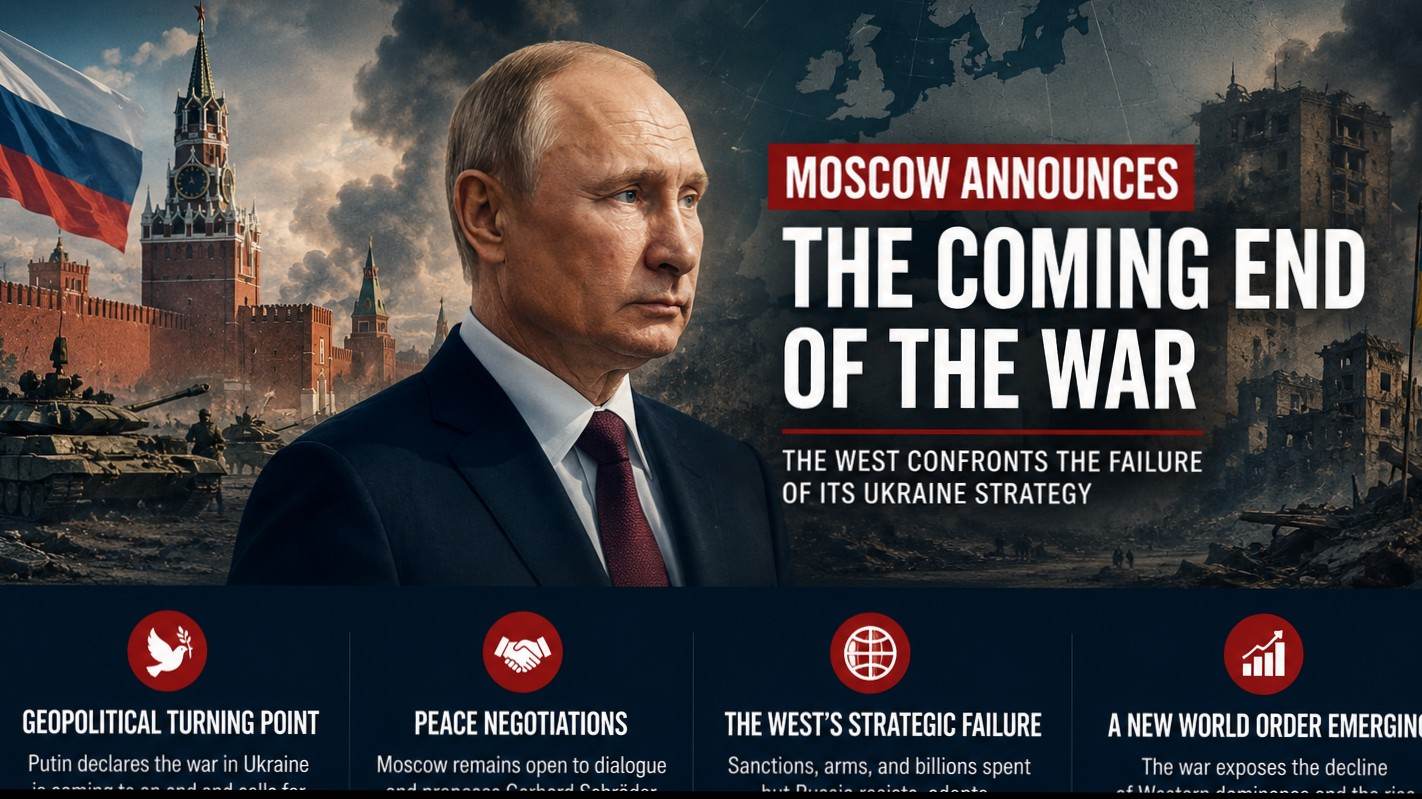
Amid the red flags of Soviet victory and the patriotic songs of May 9, Russian President Vladimir Putin delivered a statement from the Kremlin on Saturday, May 9, 2026, with major geopolitical implications: according to him, the war in Ukraine is “coming to an end.” Delivered during celebrations marking the Soviet Union’s victory over Nazi Germany, the declaration may represent a historic turning point in the deadliest conflict Europe has witnessed since 1945.
Speaking to journalists, the Russian leader stated that Moscow remained ready to negotiate a new European security order, while once again accusing Western powers of provoking the war through NATO’s continued expansion toward Russia’s borders after the fall of the Berlin Wall. For the Kremlin, Ukraine has merely served as a geopolitical instrument used by Washington and its allies to strategically weaken Russia.
Since 2022, the United States and major European powers have poured tens of billions of dollars in weapons, financing, and military assistance into the Ukrainian conflict. This massive Western involvement, presented as a defense of liberal democracy, has also enabled the Western military-industrial complex to reap enormous profits while European populations endured inflation, an energy crisis, and budgetary austerity.
At the Kremlin, Putin portrayed the war as part of a broader confrontation between Russia and what he describes as “Western globalism.” According to him, Western leaders betrayed commitments made after the collapse of the Soviet bloc by continuing NATO expansion and seeking to integrate Ukraine into the Euro-Atlantic economic and military sphere.
The Russian president also revived the issue of the failed Istanbul peace negotiations of 2022. Moscow claims that a compromise had been reached before being sabotaged by Western powers, particularly London and Paris, which, according to the Kremlin, sought to prolong the war in order to exhaust Russia over the long term.
In a highly symbolic gesture, Putin named former German Chancellor Gerhard Schröder as his preferred interlocutor for future discussions with Europe. A loyal partner of Moscow for two decades, Schröder nevertheless remains a controversial figure in Germany, where Atlanticist elites reacted coldly to the proposal.
On the Western side, reactions have ranged from skepticism to caution. Berlin stated that Moscow’s credibility would first depend on an effective extension of the ceasefire currently being observed between the two sides. The military pause, supported by U.S. President Donald Trump, is expected to last from Saturday to Monday and includes an exchange of one thousand prisoners between Kyiv and Moscow.
Despite these signs of de-escalation, the war continues to devastate Ukraine. Fighting persists on several fronts while Russia now controls nearly one-fifth of Ukrainian territory. After more than four years of confrontation, both sides appear exhausted on human, economic, and military levels.
For many observers critical of the Western-led order, the current situation primarily reveals the limits of the Euro-Atlantic strategy. The initial objective of economically isolating Russia and provoking its political collapse appears to have failed. Moscow has withstood sanctions, redirected its economy toward Asia, and strengthened its alliances with several emerging powers of the Global South.
Beyond the military sphere, the war has profoundly transformed global balances of power. It has accelerated the decline of Western geopolitical dominance, deepened Europe’s internal fractures, and revived debates over national sovereignty, imperialism, and the role of major powers in the contemporary world.
On this May 9, 2026 — a sacred date in Soviet historical memory — the Kremlin sought to place the Ukraine war within the broader historical continuity of Russia’s struggle against threats coming from the West. Whether this marks a genuine opening toward peace or a diplomatic maneuver aimed at consolidating Russian gains, one certainty remains: after four years of total war, the Ukrainian conflict is entering a new phase whose consequences will extend far beyond Eastern Europe. For their part, the United States have reaffirmed their determination to bring the war to a definitive end. The opening of negotiations with Europe could eventually lead to a lasting settlement, but whatever the outcome, all indications suggest that the greatest victim of this conflict will ultimately be Ukraine.





Commentaires (0)
Laisser un commentaire